Short answer: yes
Your neck sets the transition between your head and shoulders. A thin neck can make your head look bigger and your shoulders narrower than they are. As your neck and traps develop, that transition fills out and your upper body looks stronger and more balanced.
The change shows over months, not weeks. But since the neck is a small muscle group, it can respond faster than other areas when you train it regularly.
The neck is a sensitive area
The spine, nerves and blood vessels sit close together in the neck. That's why starting with heavy weights and sudden, swinging movements is a bad idea. The goal of neck training isn't to strain it; it's to tire the muscle in a controlled way.
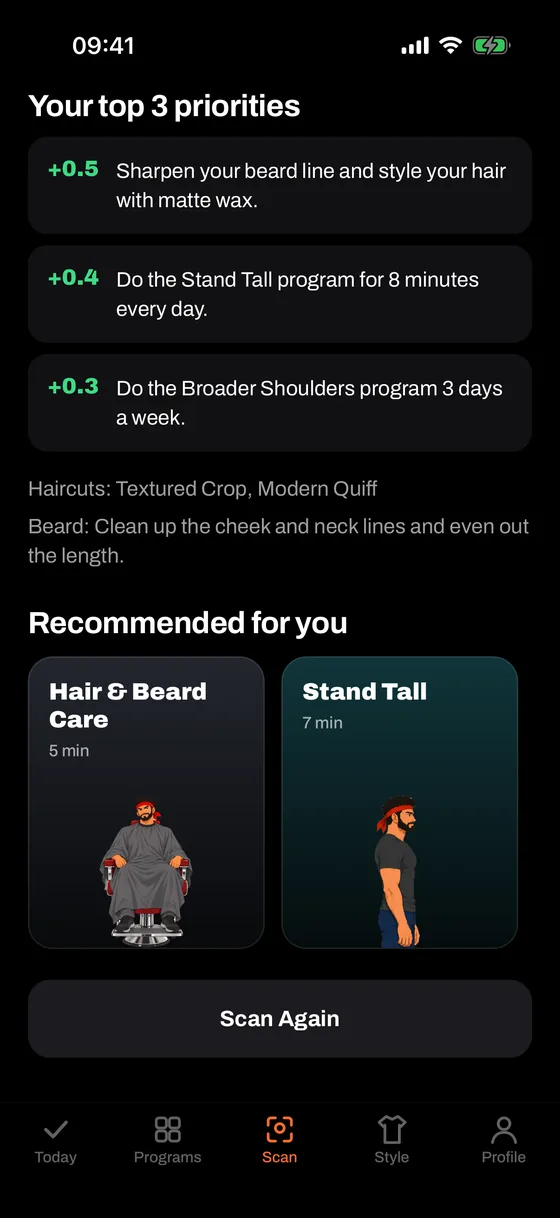
 ManovaScan your face, see your score. A routine and workout plan made for you.Download on the App Store
Start with isometric moves
Isometric means the muscle contracts without changing length, so the joint doesn't move. It's the safest starting point for the neck.
Example: put your hand on your forehead and, without moving your head at all, gently push forward with your hand while your neck resists. Hold for 10 to 15 seconds, then release. Repeat with your hand on the back and both sides of your head.
- 10 to 15 seconds per direction, 3 reps
- Push with about half your strength, not full force
- Don't hold your breath, breathe steadily
- 2 or 3 days a week is enough
Traps: the support under your neck
The trapezius is the large muscle running from your neck to your shoulders and upper back. It gives much of the look of your neck. At the gym you can train it with controlled shrugs and farmer's walks, and at home with light-weight shoulder shrugs.
When you shrug, lift your shoulders straight up toward your ears, pause at the top and lower slowly. There's no need to roll your shoulders; it only stresses the joint without adding load.
When should you stop?
Stop right away if you feel pain, numbness, tingling or dizziness. Muscle fatigue is normal; sharp pain and nerve symptoms are not. If you have a herniated disc in your neck or an old neck injury, talk to a doctor before you start.
In short
Neck muscle does change your look. Start with light isometric moves, add shrugs and farmer's walks for your traps, and stop if it hurts. For a personal training plan, search for Manova on the App Store.
FAQ
How long does it take to build neck muscle?
With regular training 2 or 3 days a week, the change usually becomes noticeable within a few months.
Is neck training dangerous?
Heavy weights and sudden movements are risky. Light isometric resistance and controlled trap work are safe for most people; stop if you feel pain or dizziness.
Can I train my neck at home?
Yes. Isometric resistance with your hand needs no equipment, and you can do shrugs for your traps with light dumbbells or full water bottles.